Friday, 2 November 2012

Georgian Military Highway


This route was an added bonus, which we only realised would be possible while we were in Istanbul. The original plan had been to take a ferry across the Black Sea from Trabzon in Turkey to Sochi in Russia as there was no land crossing from Georgia to Russia for third party nationals. However, about a month before we left home, the border was suddenly opened, and we had the opportunity to ride instead of sail. That alone saved us about $400.00 USD each, which was also very welcome, and freed money to spend elsewhere. We already had our Russian visas, which did not specify a specific entry point, and some friends had crossed there a few days before at Kazbegi, so we knew it was possible.

The highway (GMH) runs up from the Georgian capital Tiblisi, to Vladikavkaz in Russia. Vladikavkaz is actually the capital of the Republic of North Ossetia- Alania, but politicaly still remains part of the Russian Federation, and lies in the foothills of the Caucasus mountains. It's an old route, the highway having been started in about 1799 to transport troops and arms. 

We had had a hard ride across Georgia to get there, having ridden on really awful roads from the border with Turkey, and survived more really mad driving. Everybody seemed to drive flat out all the time, and skim us as they passed. Again, it wasn't an act of aggression but just the way that they do things on their roads but it scared the crap out of both of us. And because Georgia is a mountainous country, our route was dictated by terrain rather than choice, so everybody was going the same way, and on a new motorway which still seemed to be under construction.

On that road, we encountered what must be the poshest petrol station in the world. It was huge, set well back off the road, and finished in chrome and polished aluminium, and totally out of place. But there was nobody there, and not that many people passing by either. Very odd and more reminiscent of the MacLaren HQ in Surrey.

 
We saw several police convoys en route too. Big black 4 x 4s with blacked out windows and about fifteen vehicles in each convoy. It wasn't that far from Tblisi, so maybe it was the president or somebody, but we didn't hang around to find out. 

That night we stayed at Mtakheta, about 20 kms north of Tiblisi in a family home with a room for rent. The town is the ancient capital of Georgia and the place where Georgian christianity developed.  What is noticeable is the surrounding hill sides, with monasteries and churches dotted on top of them.

We were lucky too because we couldn't find anywhere at all and spotted a man walking with his young grandson along a quiet side street. We stopped, intending to ask him if here was a hotel or campsite nearby, but before we could, he offered us the room. It was ok and the family was very nice, but it was recently renovated and the shower didn't work, and there was no place to cook. But it was better than sleeping in  a hedge or pressing on, which neither of us wanted to do. And it allowed us a fresh start for the next day.

The route north up the GMH runs for about 150 miles/200 ams, and climbs steadily as it does so to about 2600metres, from Stepantsminda through the Kazbegi Strict Nature Reserve, to the border post at Kazbegi.  It got quite cold as we climbed too, and the landscape changed from spectacular and open to almost Alpine like.

We met a Dutch couple several miles up, parked up and overlooking a dam. 


They were travelling in a 1952 German fire engine that had been given to the Dutch government as part of war reparation, and they had been all over the world in it. 

Apparently they handed over about 300, but now there are only a few left, so they are quite rare. Cool vehicle though, and pretty hardy. They invited us for coffee  but we had no time as we really needed to be up and over the pass in full daylight, having been warned that the road near the top was very rough and unpaved , and a bit dodgy on both side of the border. There were also unlit tunnels - and by unlit, I mean completely dark, so we didn't want to be caught out there.

So we continued on, pausing to add a few layers as it got colder, and met a very drunk man who appeared from nowhere.


The road eventually got all hair pinned up there too, and then the road surface stopped, about 15 miles short of the border, turning to loose gravel and potholes right across the whole width. 


But bizarrely, vehicles still came whizzing down the road las if it was smoothly surfaced motorway. 


There were no trees or any vegetation up there at all, but several patches of snow and it was really open to the elements. Goodness knows what it must be like in winter, although its probably virtually impassable anyway, but they must keep the border post open, particularly now.

The tunnels were every bit as scary as we thought they would be. Hewn out of the rock, with rough surfaces and no lighting at all, some are now having roads built around the outside. Maybe its to help the expected traffic increase, while the tunnels protect the crossing from the extreme elements in winter; who knows.

The actual border post was a bit of a surprise and somewhat of an anti climax, and it is right at the top. We had hoped to change some money up there, but it suddenly appeared out of nowhere, and there were no shops or anything in it. Its probably because it was only a crossing post for Russians and Georgians until recently, and hasn't yet caught up with its new international status. 

Our arrival caused a bit of a flutter though as the guards clearly weren't sure what to make of us, but they let us through quick enough. One of the Russian guards barked something at us, but his mate just laughed and spoke to us in English. Our registration plates caused a bit of confusion too, because they are consecutive, and the woman couldn't tell the difference between JNL on Nads' bike and JNK on mine, but we sorted it by showing her the two rego certificates. Then in the customs office, they helped us fill in the vehicle forms as we clearly couldn't read the cyrillic alphabet. But as we later found out, they did lack a bit of international experience because they insisted that we had all the forms that we needed to carry on, which we did, but it turned out that we didn't have any insurance for Russia. That was ok because apparently Russian law allows you to ride or drive to the nearest town to buy some without committing any offence. 

Having crossed the border, the road was just as spectacular on the Russian side. 


There is a big Russian Army base about a kilometre or so from it, and various relics of previous border tensions, with tanks and bunkers dotted over the landscape, and patrolling armed soldiers. The scenery though was astonishing - sheer rock faces, a stoney river bed, and sun bouncing off the sides of the valley.


Thursday, 1 November 2012

To rural Kent aboard PizzaBike

Poor old PizzaBike will be my steed for the next few weeks while my left wrist heals.

It's OK for me to ride as it has no clutch, and I like it anyway as it's light and easy to ride and can be dragged out of dirt or picked up easily, should the need arise. That makes it very useful for poking about remote lanes and villages where falling off is high on the 'likely' list.

So today, starting on 19000 miles dead,  I rode her up onto the North Downs in rural Kent, on a very bright but blustery autumn day, with big black clouds interspersed with sunbursts and blue sky.

And it was cold. So cold that  I actually wore my winter gloves and about 200 jumpers. But I was still cold. My plan was to wend my way to Kent via the A and B roads to Dode, a village abandoned during the Black Death plague in about 1350. It's not far - maybe 25 miles/45kms from home.

There must have been a storm last night because there was so much debris on the roads. Far more leaves and branches than normal and lots of standing water, even on well used roads. Perhaps it was the tail end of that storm they had on the east coast of America; we usually get their leftovers in the UK, courtesy of the south westerly prevailing winds.

I followed the A25 down through Westerham, Braestead and Sundridge, to Riverhead and Seal, before turning off at Wrotham to climb up onto the North Downs. I stopped briefly at Westerham and snapped a picture of Churchill

and General James Wolfe,


both commemorated here on the Green, by separate statues. Churchill lived just down the road at Chartwell, whilst Wolfe lived in Quebec House, which was his childhood home. And if you haven't already made the connection, Wolfe was the bloke who sorted out the French in the Seven Years War, and the Battle of Quebec, which prompted the French to hand over their land possessions in Canada to the Brits.

Westerham is only a small place but it boasts two men who at different times, made a huge impact on the World and helped shape modern history. It also has some very nice teashops but I didn't stop at any today as I'd only just left home.

By the time I reached the lanes not far from Wrotham, evidence of last night's rain was all around.  I stumbled across several puddles like these, dotted around. And yes of course I rode through it but didn't get a picture as it would have meant riding no handed and even I think that is beyond the call of duty. Probably.

I just waited for an obliging car to rock up to save me walking through to test the depth as it was too cold for a swim and I had my new camera to think about.

But the views from the top of the Downs were worth the effort.


I was even colder by now and hungry, so I stopped at a chip shop. Proper chips too, none of that fries business.  And they really hit the spot as I scoffed them in the sunshine. Best I go cycling again tomorrow morning to cancel their legacy out then.

It's funny what you find hidden away in familiar places. I have passed signposts for this place so many times but have never  gone to see what lies along that lane. But it was a little church alongside a farm, right in the middle of nowhere.

And Pizzabike had a bit of a pose in the sunshine.
I dropped down into Rochester, which I hadn't meant to do, but  having ended up there, I had a quick look at the Castle and the Cathedral. Both are really impressive and overlook the River Medway.

But those clouds were getting blacker and blacker and gathering over the river.  This bit of the river was famous in the early days of aviation when the Short brothers opened a factory on the banks, just downstream. This is where they pioneered the piggy back system that the Americans later used to launch the space shuttle. Only the Short brothers, back in the day, developed it in order to run an airmail postal service  across the Atlantic, using a modified Sunderland flying boat - Maia -  and a small seaplane - Mercury. Maia carried Mercury and then Mercury took off from it, thus extending its range. Simple, effective and ingenious.

And you know that feeling of annoyance when you know you're about to get a good soaking.......

.....well I didn't as it somehow bypassed me.


But it produced some spectacular light which made even the roadside weeds look interesting.
This is the M2 bridge - in its day, the longest span bridge of its type in the World back in the 1960s. Looks tiddly now though.

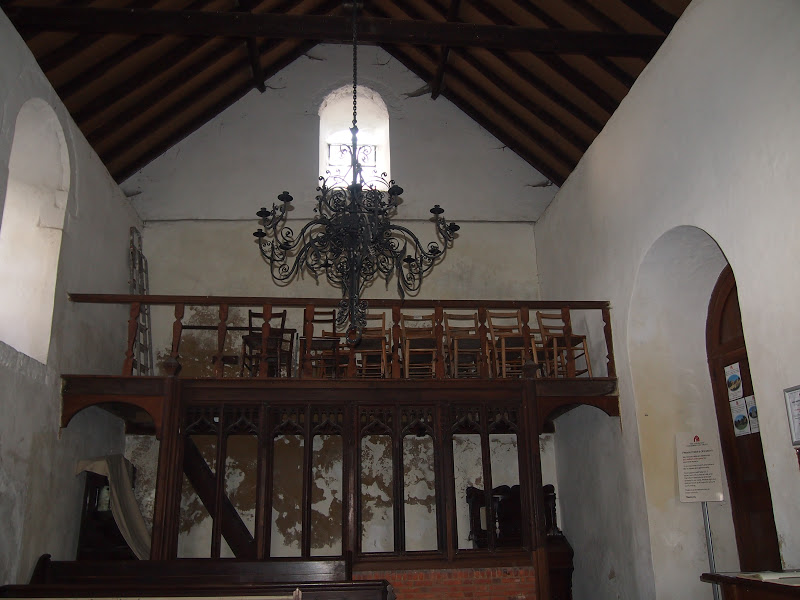
I eventually reached the bit of the Downs that I had been looking for although I couldn't find Dode, although I knew it was very nearby. A combination of being cold and wanting to get home before the sun went down and it got even colder, meant that I gave up without too much of a search; I'll save that for another day. But I did stop at Paddlesworth Church, which is in the same parish as Dode. And it was open too, much to my surprise, so I spent 15 minutes inside, out of the wind, and having a look around.


Again, it was in the middle of nowhere. Its about 900 years old, although some bits are probably a bit older. The village that it served was wiped out during the Black Death, and it was amalgamated with Dode Parish afterwards. Its still a consecrated church although no longer used for worship, and for about 250 years, was used by the nearby farm as a barn. But it was empty today.

So that was it. Time to head for home, after a round trip of just under 100 miles/164 kms. And I still didn't get wet. Excellent!

Wednesday, 31 October 2012

Ulan Bataar

Ulan Bataar - commonly and colloquially referred to as UB - is the World's coldest capital. It sits sits at 1300 metres above sea level, and in a river valley  The name means ' Red Hero', and the city started off as a nomadic Buddhist settlement which moved twenty eight times before somebody finally had enough, and parked it permanently where it is now.

I was last here seven years ago, in the winter. It was not only astonishingly cold then (-40 Celsius at night) but also noticeably quieter. I'm not sure if that was a seasonal variation or just that the place has grown, but whatever the reason, its basic infrastructure definitely can't cope, and that adds to its strangeness.

At first glance, it looks like the average modern capital city with glass buildings, flash cars, neon signs and well dressed people, all mixed in with old or traditional stuff.


But seemingly not in the same way as other major cities, with monks in full monkly robes driving the newest model cars or walking along with briefcases, and young business people chatting on I Phones or working on I Pads while riding on oxen carts. It is such a weird mix which really takes you aback.


There has definitely been a recent upsurge of wealth here, and there is now noticeable western influence with shops, cafes and bars. Go into a shop, and you will find the latest flat screen TVs, the latest phones and all manner of designer clothing. But most of the customers live in the ger communities - where there is no running water and no sanitation. It's just a different take on what is important for everyday living and what is not.


Some are imports, like pubs, micro breweries and pizza restaurants, whilst others are a mixture of Chinese imitation and local perception of what foreigners expect, even if they don't. And they don't always interpret the place names as we would......


However, it is the basic infrastructure that gives the game away; UB is a facade where very little works   as you might expect, or in such a chaotic and disorganised way, that you'd be forgiven for wondering what is going on. It is as if ideas have changed too quickly or disposable wealth arrived without a spending outlet for the city to develop systems to keep it going. It has cars, it has shops and restaurants - often operating at near western prices but far from western service levels - it has buses and banks, yet there seems to be no underlying system for any of these things and so rather than create and help develop the community and each other, they just clatter along regardless in isolation. There seems to be no overview or plan for anything in this place, just an expectation that if the raw materials are there, the place will somehow grow and work. However, that is not really the case.

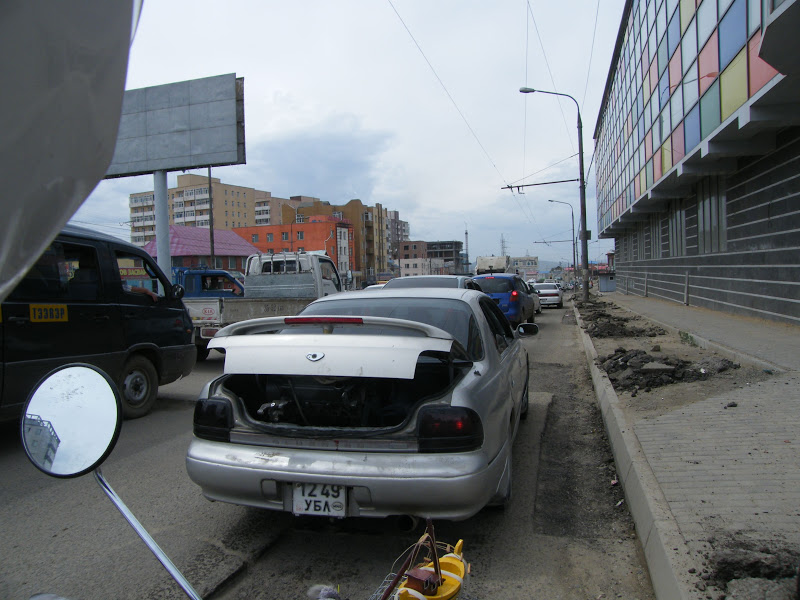
The roads are a good example. It is a small city and the road network should be adequate in terms of comparative size.....but whereas the traffic volume has increased with wealth,  the road conditions have not, and are terrible because nobody repairs them or pays taxes to allow even weather damage to be put right, let alone damage from wear and tear.


Furthermore,  their use is so bizarre that the place is gridlocked at least twice a day; nobody takes any notice of traffic signals or gives way, and it all gets so much worse when the traffic police arrive, allegedly to sort it out. Rather than facilitate flow and move obstructions, they stop vehicles arbitrarily and cause massive snarl ups. They are totally ineffective and laughably useless, although they do look the part with flashy bikes and white wellies.

We arrived in the city during peak hour on a Friday. Not the best of timing but having ridden right across Europe and Asia, we thought we'd seen it all. But UB was something else. It was almost like a fairground ride, with vehicles driving at each other and filling spaces, seemingly without any idea or hope of making progress. And of course they hit each other and blocked more bits of the road as a consequence. Yet nobody seemed to know what to do. Nobody moved crashed vehicles, nobody set up  diversions, and everybody stood around waiting for somebody else to do something. It was quite incredible, but as one woman later remarked ' these people are nomads - they are not used to roads or signs and have no idea of how to live with other people. They just drive and if somebody gets in the way, they hit them.' People just drive to where they want to go, and only a physically immovable structure will stop them, and then only temporarily. But far from aggression,  it's more to do with total incomprehension of how things work.

Then there are the banks. A 24 hour bank in the city centre that only opens between 0900 and midnight, and ATMs that only operate on Visa not Mastercard ( or the other way round - forgotten which, but it it was the opposite to what I needed) or will only let you withdraw cash in minuscule denominations.  We had to withdraw the equivalent of £500.00 in £2.50 lots to buy a replacement motorbike, which emptied the machine, much to the annoyance of waiting customers. But as the lady had already filled it that morning, she was reluctant to do it again - despite it being empty and therefore useless. Or the tourist information place where people know even less about their city than the average first time visitor. It is very confusing at first but once you accept that is just the way that it is, then it becomes easier to deal with.

Tourism is on the up too. I've already mentioned bars and restaurants and there is definitely an understanding that visitors mean cash, and people will spend it at places of interest.

But the balance of what is charged and the service received, particularly in some restaurants, is still way off,  which can be rather tedious when you're hungry and tired and have spent all day supporting the local economy in other ways. But I guess that is all part of the travel thing, and its about knowing when to just laugh and accept it, or object and move on.

'Reasonable' , 'ripoff' and 'cheeky git' haven't quite hit home yet with some chancers either, like the monk at Gandan Monastery who wanted an additional $5.00 USD per picture for general pictures inside the grounds, despite us having already paid an entrance fee. But his efforts were wasted on us and he didn't get any dollars at all in the end.......but he did get some free advice, especially from Nadine.
          This bloke was on the phone in between hitting the gong for prayers


Or one waiter who took our order in a restaurant but neglected to pass it to the chef because he wanted to practise his English on us. Not funny late at night when there is nowhere else to eat.

But then we also went to places that were completely free and spectacular, like the Ziasan memorial on a hill to the south of the city.

It commemorates Soviet soldiers of WW2 and is now a bit tatty and dilapidated, but its probably one of the best places to look out over the city.
Zaisan Memorial overlooking the city

What is evident from there though is the extent of spread of the city in the last seven years. New apartments have sprung up everywhere, and the Winter Palace, once clearly visible from Zaisan, is now hidden amongst new buildings.

But for us, UB  was always the main point of the journey, and anything further would just be a bonus.  It was our original destination, and a place that at until we reached it, always seemed so far away. But I don't  think that either of us really seriously ever doubted that we would make it.  Not aboard our trusty scooters.
scoots on Zaisan Hill